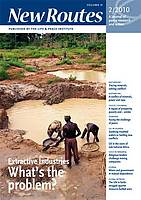
NUMBER 2, 2010 Extractive industries...what's the problem?
No, indeed. It can also be diamond, coltan, cassiterite, or, why not, the black gold: oil. Whether literally glimmering or not, these minerals represent wealth and richness in the eyes of fortune hunters, prospecting companies and mining industries.
– We are seen as cursed people in the midst of natural resources, says an older citizen in one of Tanzania’s gold rich areas, quoted in one of the articles in this issue.
Tracing minerals, solving conflict? Ruben de Koning
A conflict of minerals, power and rape Margareta Svensson
A region of prosperity, poverty and – smiles Henrik Halvardsson
Facing the challange of peace Lulsegged Abebe
Soothing troubled waters or feulling new conflicts Jessica Banfield
Oil in the veins of sub-Saharan Africa Kjell Aleklett and Kristofer Jakobsson
Religious leders challange mining companies John Magafu and Godfrey Walalaze
Mines and goverment in mutual dependence Marc-André Boisvert
The UN in futile struggle against resource-fueller wars Matilda Persson
Resours list
Why is it that many regions where the mountains, soil and waters abound with mineral resources are the most miserable places, keeping their inhabitants in an iron grip of conflict, poverty and disease? The root causes are quite complicated and differentiated, but greed, lack of transparency and lack of responsibility are some obvious reasons. Where big international mining companies exploit a country’s richness without giving the local population its fair benefit, people are left in poverty, sometimes also with severe damages on their environment. Where the revenues from valuable minerals are used to prolong an armed conflict, people are captured in a trap of war instead of harvesting the richness of their habitat. Where rivalling powers contest the control over mines or oil deposits, what could be a blessing to the community turns into a curse of violence and death.
A flagrant example of this is eastern Democratic Republic of Congo, where an abundance of natural resources feed a seemingly everlasting conflict. Margareta Svensson and Ruben de Koning, in their articles, present an analysis and reflection on the situation.
The necessity of oil for Africa’s future development is explored by Kjell Aleklett and Kristofer Jakobsson, while Jessica Banfield discusses what the oil in Uganda might imply for the future of the region.
Henrik Halvardsson, based in Colombia, gives a vivid picture of the Chocó region struggling for its survival, in spite – or because – of its abundant natural richness.
But the opposite may also happen, like in Liberia and Sierra Leone. Lulsegged Abebe in his article says that “it is time to move away from the negative stereo types attached to diamonds and coin a new label: peace diamond”.
You will find thought provoking and challenging reading in this issue of New Routes. If you want to fill in the discussion or present a divergent view, do let us know!
Här går det bra att gratis ladda ner
New Routes 2, 2010
Kristina Lundqvist
Publicerad: 2010-08-09
Köp New Routes
Läs mer om New Routes i katalogen
Fler artiklar knutna till New Routes
Fler tidskrifter i kategori SAMHÄLLE, MILJÖ & POLITIK
Fler tidskrifter i kategori GLOBALT